Thursday, August 3, 2017

Japan: Hokkaido 2 - Toyako to Hakodate

July 8 - Toyako to Hakodate

Starting our first JR pass today (6 days of travel over 14 days), we train back to Sapporo, then to the lakeside resort of Toyako. It’s a heavily developed resort that has seen better days, I’m hoping for some picturesque decay to offset the big hotels along the lakeshore.

It’s good to be on the long distance train trips at last, like so much else in Japan, the system is efficient, well-organised and designed for human comfort. It is expected that you will be picnicking on the train, and stations all have takeaway food options for the purpose. It’s also expected that you will take gifts home for friends and relatives, and even larger stores display heavily packaged gift food items (see previous post). From Furano it’s a 4.5 hour ride, with two changes, to Toya, then a short bus ride to the lakeside of Toyako Onsen. It’s an infrequent local bus with no luggage facilities - one assumes the upmarket resorts run shuttles? I was worried that the hotel (Granvillage Toya Daiwa Ryokan Annex) would be tacky in spite of its grand name, but it’s fine - a smaller, no-frills, slightly shabby alternative to the big expensive hotels along the strip. Our room is large and tatami floored with a large dusty picture window framing the lake. We have a sink, toilets are shared, and bathing is communal - very Japanese-y.

We take a walk along the lakeside at sunset then find a ramen place for dinner. Mine is shoyu ramen with no extras, and is ok, but Chris’s miso ramen is delicious. We are back at the hotel in time to view the nightly firework display over the lake. Wow! It’s surprisingly fabulous!

View from our room
Chris in yukata
Sunset swans
Night-time fireworks

9 July - Toyako

What a nice view to wake up to! There’s really only one excursion out of Toyako, and it’s to Mt Uzu, a (barely) active volcano, and its baby, Showa-Shinzan, born 1943-45, documented by a local postmaster. It’s a brief bus ride to a row of tacky gift shops, saved by their decrepitude, then an expensive cable-car ride to the crater and a short hot walk to the summit. It’s underwhelming really. We mooch around taking photographs of other tourists, before taking the cable car down again. At the base, there are apparently an Ainu museum, and one dedicated to intrepid vulcanologist/postmaster Masao Mimatsu. It’s quite a trek, un-signposted, past carparks and shuttered shops, to a reproduction of an Ainu house, with old photos displayed, and a fire burning inside - lovely. Then to a small ‘cultural centre’ for the MM museum. It’s a tiny, charming display, full of old paper artefacts - drawings, papers, plans and journals. But I have only 10 minutes before the bus goes, dammit!
Back to the hotel for a bath, which is SO hot that I and three other women are all crowded into the one end that is cooler! Then another picnic, by the lake while we wait for fireworks. It is a beautiful, soft summer evening, and slowly the hotel guests come out, some in yukata, to promenade and see the show. The crazy kitsch cruiseboat ‘Espoir’ glides across the lake like a fantasy floating castle - more Miyazaki - it’s a sweet holiday atmosphere.
Chris with 'baby' volcano Showa Shinzan
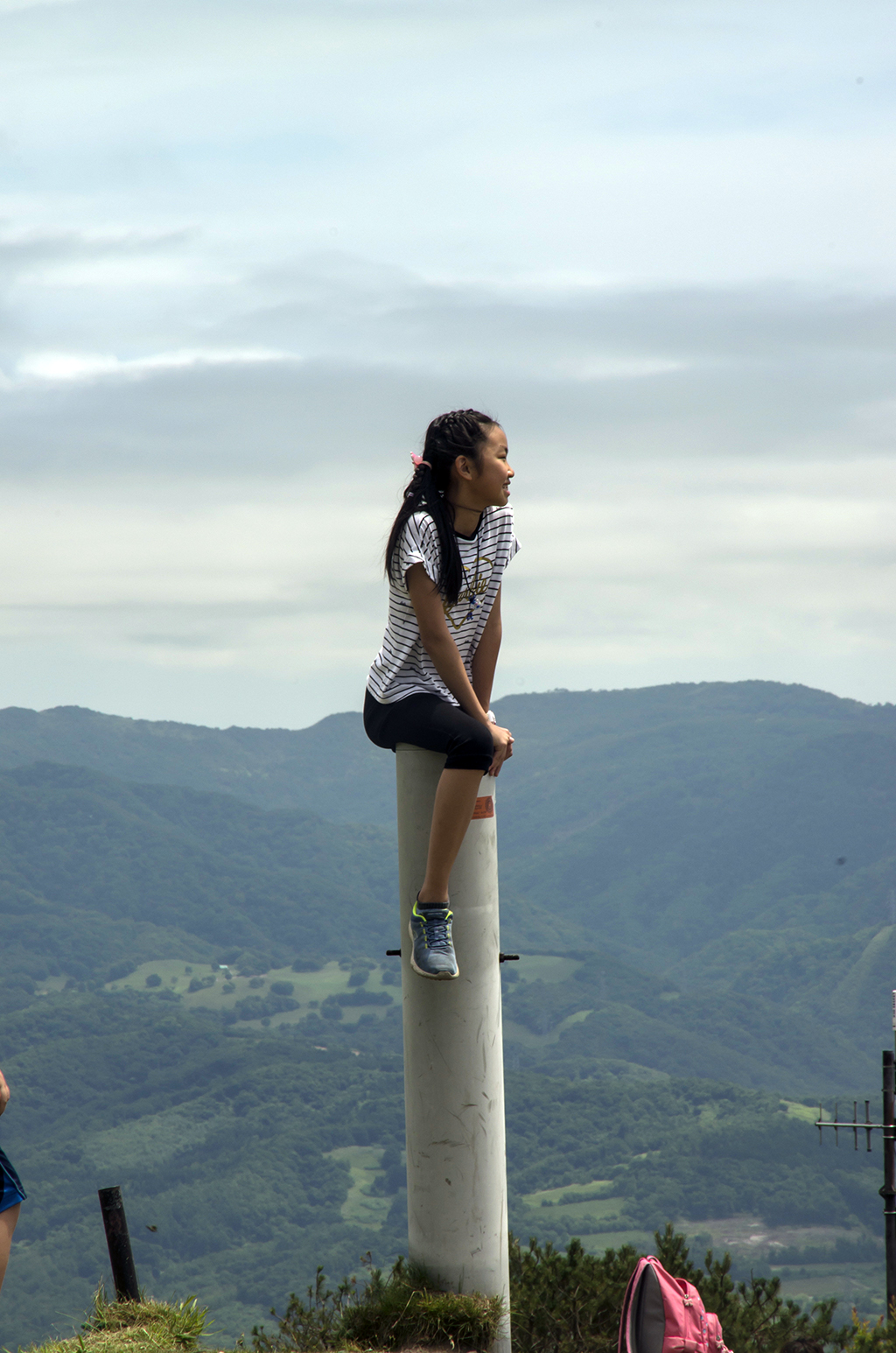
Tourist at the top
Ainu museum
Promenade
'Espoir' at twilight

10 July - Toyako to Hakodate

It’s just a short train ride, less than two hours, from Toyako to Hakodate, so we have time to ride in the ‘Espoir’ around the lake, and to Ojima Island. At the island we have just 25 minutes before the return boat, but that’s ok, the map shows a forest walk that’s ten minutes each way. It’s a good thing that Chris decides to wait by the dock, as the ten minutes each way is more like 15, and I’m almost sprinting as I get back to the dock, where the boat is at the point of leaving, five minutes early. Phew. Takes the whole ride back for my heart to return to normal, definitely not as fit as I should be!

Back on the bus, and to the station, for the Hakodate train. Looking at the map, it will be a 20 minute walk around the waterfront to our guesthouse, Jokura. In the event, it’s a hot, mostly shadeless walk through the fishmarket (one of our first sights - a giant octopus in a tank, awww!) and along an industrial dockfront, until we reach the old brick warehouse tourist strip more than halfway along. Still hot, but a more pleasant walk.

Our hosts greet us with a cool drink and warm welcome. Mr and Mrs Sato, a kind and generous couple manage their small and impeccably clean guesthouse like a family home, crammed with artefacts from Japan and abroad. I particularly admire an Ainu gown, and find that the Ainu Museum is just down the road.

After the usual siesta we walk to the waterfront warehouses, the touristic centre and the site of many restaurants. As we haven’t yet tried it, we choose a conveyor belt sushi place.  Have no idea what to do and no English is spoken, but the ipad ordering system has an English option so we order one or two things that arrive promptly - then go for it: salmon, grilled eel, salmon roe, tempura prawns … it’s all good. Not sure what to do about dishes on the conveyor - are they up for grabs or pre-ordered? Seems that some are, some not, so we leave it alone (find out later that pre-orders are specially marked, so will have to try that later). After a satisfying amount (about 10 dishes? Nowhere near the 30+ of the couple next to us!), we settle the bill - with sake, about $20 each, pretty good value. Grabbing some more supermarket sake we head to the waterfront for a post-prandial tipple as the sun sets, and drink in the balmy summer air.
Chris and giant octopus

On the waterfront

11 July - Hakodate

We haven’t booked breakfast at the guest house, because the Hakodate morning fishmarket is famous for seafood breakfast. So we head over there (had a glimpse yesterday on the way from the station), and it is huge. Wander for some time through street stalls and a restaurant arcade, with relentless displays of plastic seafood donburi (rice bowl). One of the promoted dishes has a newly decapitated squid (with eyes intact) sitting atop a rice bowl. A video display demonstrates how it squirms as sauce is added, sometimes toppling right onto the table. Not appetising to me, but it does have a ghoulish fascination.

We find a seat in one of the main market areas, just near the tank where visitors can fish for squid, then watch as it is prepared for consumption (raw of course), and a bbq stall where huge scallops are being grilled on their shell. We try the scallops - delicious, but at about $9 each a pricy treat. More wandering - how do they sell so much seafood? How does it stay fresh? We share a donburi with salmon and prawns, and another with salmon roe and uni (sea urchin roe) - about $15 each. On top of the sushi last night, feeling about raw-seafooded out - never thought I would say that!

Today we get a tram pass ($8 each) so we can explore from one end of the track to the other. First to Goryokake Park, and the remains of an old 19th C fort. The Japanese do very good parks, but in the end it’s not as interesting as the walk on the way there ...

NOTE on Hokkaido history - because (mainland) Japanese and Western history in Hokkaido did not really begin until the mid-19th C, the documented, recorded and celebrated history is quite shallow. As it is in Australia, the history of indigenous cultures is treated as something apart, not relevant to ‘development’, and not leaving many visible traces.

Again, it’s a hot day so we check out the Art Museum nearby. An interesting show on Japanese Realism (trad to contemporary), and a very small permanent collection. For $15 entry, it’s rather overpriced, but cool. On the way back to the bus stop a quick stop at MUJI for stationery gift items and some upmarket snacks. Then out to the end of the line at Yunokawa - it’s uniformly grungy suburban, no tourist spots here. We briefly explore a small temple area, then head back.

Planning a wharf picnic tonight - we still have ekiben tonkatsu left from our last train ride - we buy a few extras (of course, sake) and resume our wharfside spot.
Decapitated squid - plastic version!

Grilling scallops

Eating scallop

Preparing uni (sea urchin roe)

One of a thousand seafood stalls

12 July - Hakodate

We have discovered another gorgeous bakery nearby, so pass by there to pick up breakfast (egg & bacon pie, cream cheese and green onion roll) on the way to JR to make reservations. Lucky we did - Shinkansen are almost booked out! On our way we explore another little backstreet temple area. Like small neighbourhood churches they can be more charming than large, historic edifices. This one is quite crusty, and I find a lovely charred fragment of an old wooden calendar relegated to an incinerator. Then back on the tram to the other end of the line, but Chris is weary, and gets off near our guesthouse, and I continue to the other end of the track - Hakodate Dock and the Foreigners’ Cemetery.

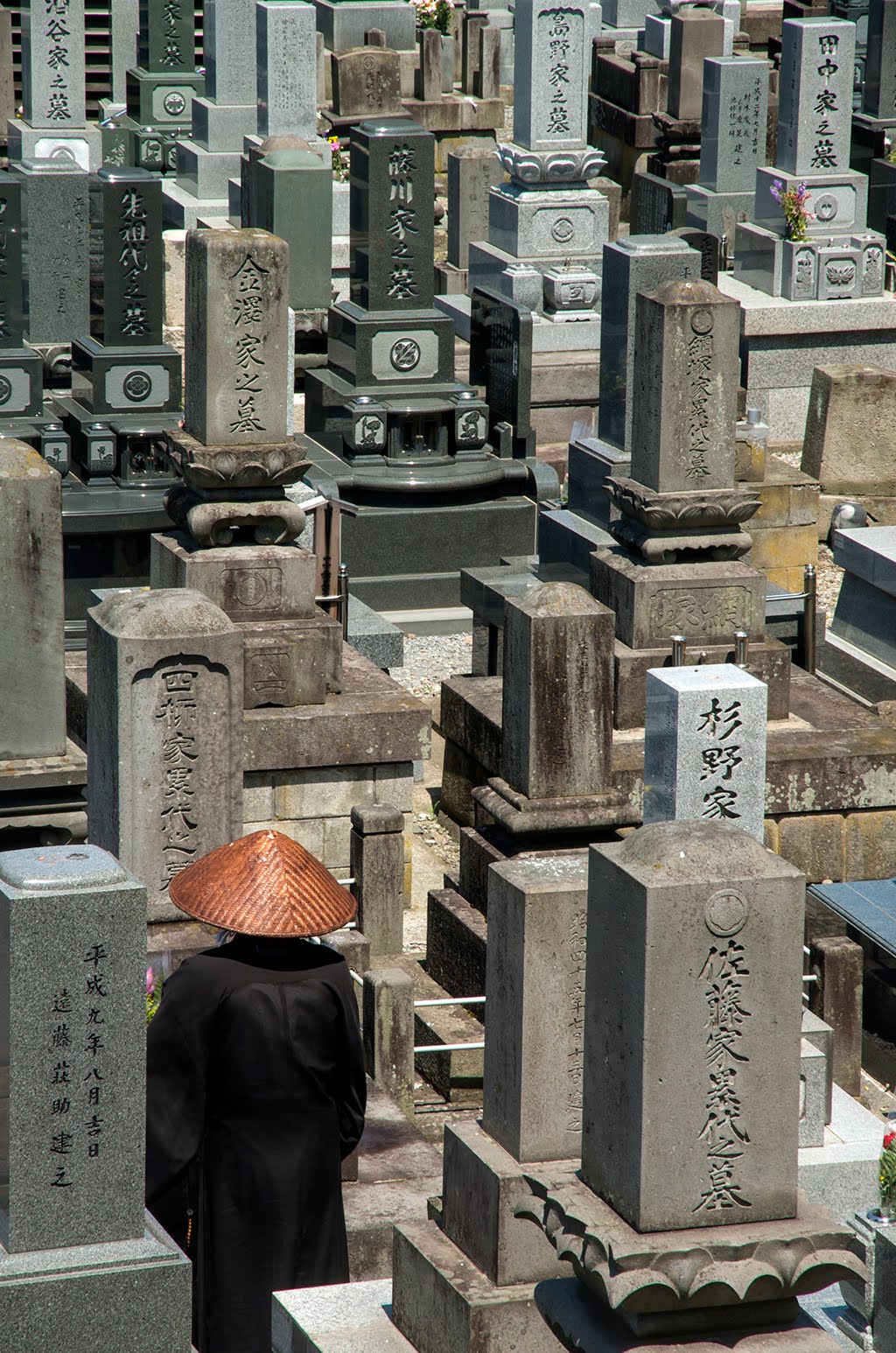
What a gorgeous walk it turns out to be! The neighbourhood is quaint and crusty, the street lined with flower shops. Because out near the point there is not only the Foreigners’ Cemetery, where Europeans were buried in the times of early settlement in Hokkaido, but also a Chinese cemetery, Russian cemetery, and an enormous Japanese Buddhist cemetery, where a monk is conducting a graveside ritual. It’s a bit hot and sunny for the best atmospheric cemetery photos … but still … a monk gives me a pack of incense, and there’s a nice pathway along the coast.

I have promised to find lunch and hurry home, stopping for bento at a supermarket on the way. There’s a great selection, including a fab sushi tray - I’ll remember that for dinner. Back home to Jokura, for lunch and rest.

We had planned to go up the ropeway for sunset views from Mt Hakodate, but online reports of the tourist rush there is off-putting. Instead we walk through the scenic old area of Motomachi, via the Old Govt House, back to the cemeteries. I know what we can eat and where to sit!

It’s a pleasant and picturesque late afternoon walk. But it’s almost sunset by the time we reach the cemeteries and we haven’t bought anything to eat. There’s a cafe, not quite closed, and we have a quick coffee and snack. Gorgeous cafe lady is a sailor who has been to Sydney, and the view is also gorgeous. Now it is seriously dusk, and we hotfoot it back to the supermarket to find sushi. Alas we are too late! Only leftovers - limp fried shrimp, chicken and salad. And of course sake. We head back down to the waterfront, but it’s quite industrial here at the docklands. Finally we spy a pathway to Midori-no-Shima (Green Island), a man-made promontory park. It’s properly dark now, and hard to see what we are eating, but it’s fairly ordinary … Y’know, I think I’m a bit over supermarket takeaway.

Walking home, I need to eat something NICE, and close to home we see a Spanish restaurant and stop for a glass of wine and garlic prawns to share. Expensive, but worth it!

End of the line - evangelising at Yunokawa
Crusty streetscape - on the way to Hakodate docks
Other end of the line - Buddhist cemetery

View of Hakodate from Motomachi
View from cafe, Foreigners' Cemetery

13 July - Hakodate-Hirosaki

Sadly the Ainu museum has been closed the last two days, so I will not get to visit. So, a quick visit to the Old Haberdashery museum, showing the history of trade in Hakodate, then train ride off Hokkaido and onto Honshu, via the longest underwater tunnel in the world.
The Old Haberdashery Museum


Japan: Communications and Takeaway food

COMMUNICATIONS

Thank goodness there is now a lot of English signage in most places, and maps are usually available in English, because otherwise it would be very difficult - very little English is spoken, particularly in regional areas, although there is an abundance of goodwill and helpfulness. There are stories of foreigners (gaijin) being refused service at restaurants, although we have not found this, but certainly many restaurants have no English signage or English menus and we are reduced to pointing at pictures. It results in a feeling that we are forever floating at the periphery of life here - unless we learn Japanese of course!

Technological communication, on the other hand, is just fine. We have rented a mobile wifi device and are able to be online (on phone, ipad or laptop) any time we need. Google has a reasonable website translation function, and most people respond promptly to email communication, so we really don’t need to use our phones at all. Just as well as roaming is so expensive - Chris has made several 'pocket calls' in the first couple of days so I turn his phone service off. It gets turned on just once, so that we can text each other when I go shopping alone, and hey presto! Dave calls him from Sydney to chat about the footy. Grrr!

Signs ...

... signs ...

... everywhere the signs


TAKEAWAY FOOD

One of the first food surprises is the amazing array of ready to eat meals available at every convenience store and supermarket in Japan. Japanese ‘bento’ (lunchbox) dishes such as sushi, katsu (crumbed cutlets of pork, chicken or fish) and noodle salads sit alongside pasta dishes, sandwiches and filled rolls, and all are super fresh and cheap. But the convenience store range pales beside offerings at a larger supermarket which includes great arrays of freshly prepared sushi and sashimi, freshly cooked fritters of all kinds, and a range of bakery items. When we finally reach the big city, the bar is raised again - amazing sashimi platter on grated daikon from our local supermarket for about $8. What I was impressed by at 7-11 looks pretty ordinary now. It’s a picnickers dream.

As well, there's the omnipresent vending machine. Most dispense an amazing array of cool drinks, some hot drinks, some alcoholic drinks as well, and some ice creams and sweets. We did not see any of the legendary (mythical?) pantie-vending machines ...

So how is all the ensuing rubbish dispensed with? Well, it can be hard to find a rubbish bin, and littering is definitely taboo. We realise that at many locations where fast food is dispensed (combini, tourist shops, railway stations) there is also an array of bins for sorting the rubbish - paper, plastic, glass, metal ... Japanese generate an amazing quantity of waste, but they are also amazingly conscientious about recycling.

Supermarket shopping

GIFT FOOD

One of the choicest takeaway items is the ‘ekiben’ (station bento) - a special bento box designed to take on train journeys. They are more expensive than a regular bento, but always beautifully prepared and packaged, and designed to be very easy to eat while travelling. But I was having trouble finding ekiben at the train stations - the shops are overwhelmingly stocked with ‘gift packages’ of food. Dried or vacuum packed local delicacies, boxes of novelty cakes, cookies and sweets, food made to resemble cartoon characters … none of it designed for picnicking. The Japanese have a strong tradition of gift-giving, and buying gifts for friends and family when travelling long distance by train is obligatory. Travellers could be seen boarding the train with big bags of beautifully boxed gift food. But where to find ekiben? Usually at a tiny little stall very close to, or even on the train platform.

Gift food 1
Gift food 2

Ekiben packed

Ekiben unpacked

Ekiben lady, Toya Station


Tuesday, August 1, 2017

Japan: Hokkaido 1 - Sapporo to Furano

3 July - Sydney - Tokyo

It is not an auspicious start. We wake at 4am to get to the station at 5, the airport at 5.40 - to find that our flight is delayed by two hours. And we will miss our connecting flight to Hokkaido. But don’t worry, says the check-in guy, there are plenty of other flights. So, after a long wait, the flight is fine, and the sake delicious, though the food is bland. Arrive in Tokyo to find - all other Hokkaido flights leave from Haneda (we are in Narita, 90 min bus ride away) , and it’s too late to connect tonight. Not  happy … but nothing to be done … we are given a ticket to Haneda, voucher for hotel and meals, and flight in the morning. So - the hotel is bland but smart and comfortable. Dinner a beyond-boring school meal, but breakfast a fresh and extensive buffet of Japanese and western food. No, didn’t Instagram it! But at last I feel as if I’m in Japan.
Bus-ing between airports, Tokyo

4 July - Sapporo

Early flight to Sapporo - small scare when check-in girl says that the flight is full, but she just means that we can’t sit together. No problemo. It’s just a 2 hour flight, and easy to find the train to Sapporo central. A 20 minute walk to the Weekly Sapporo 2000 hotel turns into 40 minutes with detours. The CBD scenery becomes grungier until we are in a downtown neighbourhood of bars and love hotels. This would be it then! The room is small but crammed with facilities including kitchenette, ensuite (with bath!), desk with LAN, small double bed, couch and coffee table.

After check-in, with free soft drink, off to explore and find lunch. We are making up for lost time, and just a few minutes away is Uonosuke seafood restaurant, where we order seafood bowl, tempura and chilled sake. Totally delicious! The bowl has salmon and other raw fish, prawns and salmon roe, served over rice. The tempura has prawns and vegetables - eggplant, asparagus, pumpkin, onion … crunchy and succulent. Price including wine -  about $60. No, didn't Instagram it!

The rest of the afternoon, wander in a sake haze, exploring the city. Seafood market, pachinko parlours, that crazy Japanese mix of modern, kitsch, crusty and rustic that reminds me of Miyazaki movies. Wonderful to see a city dominated by bicycles, with little traffic, and great courtesy to pedestrians.

After a nap, off to find dinner at one of the tiny local izakayas. We walk over to the fish market, mostly closed at this hour, then to ‘Ramen Alley’, famous soup arcade, but aren’t inspired. Near to our hotel is a strip of small places - one is Italian, one is sushi (and packed), the next looks just right, a casual yakitori place with a dozen seats. We drink more sake, and eat a variety of skewers - (chicken, chicken liver, pork and ginger, stuffed shitake, eggplant) with a crunchy cabbage, seaweed and sesame salad. YUM! No, didn’t Instagram it!
That’s it, we are exhausted. Back to our tiny bed.

Our 'downtown' neighbourhood
Seafood delights - in plastic
Sapporo bicycles
Mix of modern and rustic
A Miyazaki moment ...
More plastic food!
Our yakitori joint - ginger wrapped in pork, yum!

5 July - Sapporo

First thing to do is to find breakfast. Not so easy in this night-life neighbourhood - everything is closed. Unlike many other places in the world, no-one is grabbing coffee and/or breakfast on the way to work.

At last in Odori Koen, the pretty central park bedecked with competitive flower displays, we spy a sweet corn stall, selling hot grilled cobs for Y300 (about $4). It’s good, and sustains us until we find a great bakery, where we pick out some delicious snacks - bacon roll, fried chicken and sweet, creamy cheese tart - divine. In Japan even the fast food is mostly great.

Today we plan a day trip to Otaru, seaside fishing village of reputed charm. After a scenic 30 minute train ride, it looks just another middle sized, modern utilitarian Japanese town, the charm all squeezed into a strip of restaurants in old warehouses along a canal near the waterfront, that is teeming with daytrippers.

We skip out asap and take a boat to Shukutsu around the point, where we are deposited at the end of a long crusty wharf in a very authentic fishing harbour. This is a real fishing village, very few tourists, but lots of old nets, buoys, boats and other functional (and picturesque) detritus. On the small main street along the harbour is a large fish bbq cafe, speciality: herring. They have no English menu so we are forced to select by picture - a bbq herring ‘set’ and a raw seafood ‘set’.

If the seafood bowl we had yesterday was the tourist version, this seems more ‘authentic’ - how many ways can you eat raw squid (including fermented in squid ink)? There’s also octopus, an unidentified raw fish and some kind of sliced shellfish. Accompaniments are the ubiquitous grated daikon, shredded daikon and cabbage, wasabi, pickles and miso soup with small whelks. All very fresh, but maybe more more interesting than delicious. The bbq herring is very good, with guts and all, charry and salty, with another set of accompaniments and more raw squid! We do our best but can’t quite manage it all, absolutely stuffed for Y3900 (about $45). No Instagram! OK, I give up, there will be no food pics on this blog, but lots of grungy street scenes and gardens!

Now, we need a walk. Up the hill to Nishin Goten, a fishermen’s dormitory and dwelling from the herring fisheries heyday in the late 19th C. Then to Nishin Goten Villa, the big boss’s house - a gorgeous, elegant Japanese mansion with garden, so incongruous in this tiny fishing village. Can’t help thinking of the indigenous (Ainu) locals who lived on the herring here before mainlanders came along, commercialised, and made their fortunes, the ‘illiterate’ locals reduced to labouring for them, or displaced entirely.

We have walked off lunch, and now back on bus and train for Sapporo. We won’t need dinner tonight, maybe the ‘Booze and oysters’ bar down the road? Sadly, can’t face more raw seafood today! So it’s a tiny bbq bar for Jingisukan (Ghengis Khan - lamb, grilled on a rounded bbq said to resemble the despot’s helmet), bbq pork and of course sake.

Odori Koen flowers
Otaru canal
Shukutsu wharf
Fishermen's dormitory, Shukutsu
Grilled herring, Shukutsu

6 July - Sapporo to Furano

We check out and head for the station, buying sandwiches for the trip, and an expensive espresso from a flash cafe (Y600 ea, about $7.50). It’s a cheap ($25) bus ride to Furano in the ski fields of central Hokkaido, turned vegetable gardens and lavender farms for the summer.

Furano is another large-ish modern utilitarian town. And HOT! Did I mention that the ‘cool’ summer weather since we arrived in Hokkaido is about 10 deg above average due to a heatwave? Don’t think I’ll be needing the jacket I brought … Our accommodation is a 10 minute bus ride away, but the next bus is over an hour away, so we resort to a taxi. Kitanomine is a bland ski-resort suburb with an artificial air, but as in Kashmir, another cold, mountainous region, the summer gardens are filled with vegetables. Our guest house is cosy and clean, and nearby is a river and beautiful park. The room is Japanese style with a low table on tatami, to be replaced with a make-your-own futon bed in the evening, and the bathroom is communal.

We rest in the hot afternoon, then walk down to the river - surprisingly inaccessible - and through an uncharacteristically unkempt end of the park. It’s a lovely spot, and the sun is setting, so we grab takeaway noodle salad and sake from the 7-11 (convenience food here is quite amazing), and picnic in the park as the almost-full moon rises.

Furano veggie garden

View to the ski fields from our lodging
Picnic park with moonrise

7 July - Furano

Today we must go and see the famous lavender fields. Say Furano to anyone, they respond ‘Lavender!’ And posters show huge fields of purple, striped with yellow, red and white flower beds. I am familiar with the Japanese propensity to enlarge to mythical proportions quite mundane points of interest (Big Pineapple anyone?), and the lavender fetish is a great example of this, so my expectations are muted. It is more an opportunity to see selfie-mad Japanese tourists in the lavender-scented wild.

After checking out a bewildering array of bus tours, we aim to keep it simple - public bus to Biei village, then the ‘Lavender sightseeing train' (Norokko-go) to the Tomita Lavender Farm. The train, an old rattler decorated up for the season, has wooden seats and large open windows, but is already packed when we join it, and we get the last window seat, in the sun. Phew! It’s already hot at 10am, the sun rises at 4am.

The ride is through green farmland interspersed with small towns. Pretty in parts, but no lavender yet. In 30 min we are at Lavender Farm and 100 or so tourists (almost all Japanese) pile off and trundle past melon fields and over the path-less bridge to the farm - an OH & S nightmare. ‘Melon World’ is the first sight that greets us. A giant cartoon melon sign, and accompanying large inflatable, herald a complex of gift shops and snack shops focusing with Japanese intensity on the melon. Newly picked and beautifully packaged specimens are on display (for gifts of course) at $30-$100 each. Or there are melon slices, smoothies, ice creams, cakes … Typically non-compliant, we down a (disgusting) coffee, and head over to the Lavender Farm. Yes, there are a few fields, with pathways between, of lavender and other coloured flowers. No, it is not like the posters, the lavender perhaps not flowering as profusely as usual, or the season is not quite right? Yet there are several dozen tourists braving the heat to wander through taking photos and a thousand selfies (thank goodness for the parasol! So picturesque). Now the gift shop theme is lavender - oils, soaps, bath bombs, potpourri, hats, shirts and parasols … and lavender ice-cream, which we try, and it’s not too bad. A quick stroll through the lavender field then back to the station, Phew it’s hot. A fellow traveller tells us that she went to Australia on her honeymoon, to Sydney and the outback, and it too was hot!

The best option for dinner after a siesta seems to be another picnic in the park. We are 7-eleven’s best customers. Prawn omelette, bread and salad, with a cheap Bordeaux, except … oh, it’s not omelette, it’s a creamy pasta. What happens when you can’t read the label. Still, it’s tasty :)

I bathe late in the communal bath, and tonight I am sharing it. Goes without saying that shared nude bathing is a bit strange for me, I wonder if the Japanese ladies find it equally strange to have me there? Of course, they are impeccably polite.

At the bus stop
The Lavender Train
Melon World
Lavender ice cream
Lavender selfies 1
Lavender selfies 2

HOKKAIDO

The indigenous people of the northern island of Hokkaido were the Ainu, living relatively unmolested until the mid-19th C, when Japanese mainlanders decided there were resources to plunder (sorry, develop), and that they needed to defend Hokkaido from Russia to the north. By the end of the century Ainu customs and language were banned, and Ainu people were forced to assimilate. While this policy was rescinded in 1998, Ainu culture was not formally recognised until 2008! There are occasional small museums for commemoration of the culture of these original inhabitants, but seems no real enthusiasm for celebration. So unsurprising really, the story of indigenous cultures worldwide. But there is some re-development of Ainu culture and language on the SE coast of Hokkaido, so maybe it can eventually survive ...
Ainu Museum in Sapporo