Saturday, December 15, 2018

Chandelao and Jodhpur, weddings and animals

See the whole Photo gallery here.
I have reluctantly given up on the idea of bus transport, so it is another car to Chandelao - the smallest village yet - where another old fort, Chandelao Garh, is refurbished for accommodation. There is no AC in the van, and what looks like a 1.5 hr drive is actually 3 hours, an experience that’s becoming familiar. Again the driver doesn’t trust Google maps, but prefers to rely on directions from locals - usually (but not always) a safer bet. Bumpy road, minimal signage - just as we think we are lost, we are there. The ‘deluxe’ and ‘super-deluxe’ rooms turn out to be actually a bit crusty, and ours is a bit lacking in furnishing - no desk, sofa, bedside table, clothes hangers or towels. But it is spacious with hand-painted decoration and woodblock prints, and is tolerably close to the wifi spot. We ask for some of those extra items, and all is good.

We haven’t planned to go out, but there is some VERY loud music emanating from the nearby village, so Chris is out hunting for dancers to star in his movies. Jackpot: the nearby house that is broadcasting the music is populated by dancing girls who beckon us inside - it seems that they are are practising for an upcoming wedding. They are very happy to be videoed by Chris, and urge me to join them, but after the Bagar experience I am happy to play demure today, as befits my mature status.

Dinner, which was planned to be under the stars on the terrace is moved to the subterranean dining room - apparently there are too many guests. It’s a nice room, but I’m a bit sad not to be eating outside - it’s a beautiful evening. In spite of the buffet style, the food is very good - fresh, homestyle curries - if a little lacking in chilli. The English couple next to us say - Yes, it’s quite nice, glad it’s not any spicier - so that is what they have to cater for!

Sunder Rang craft ladies
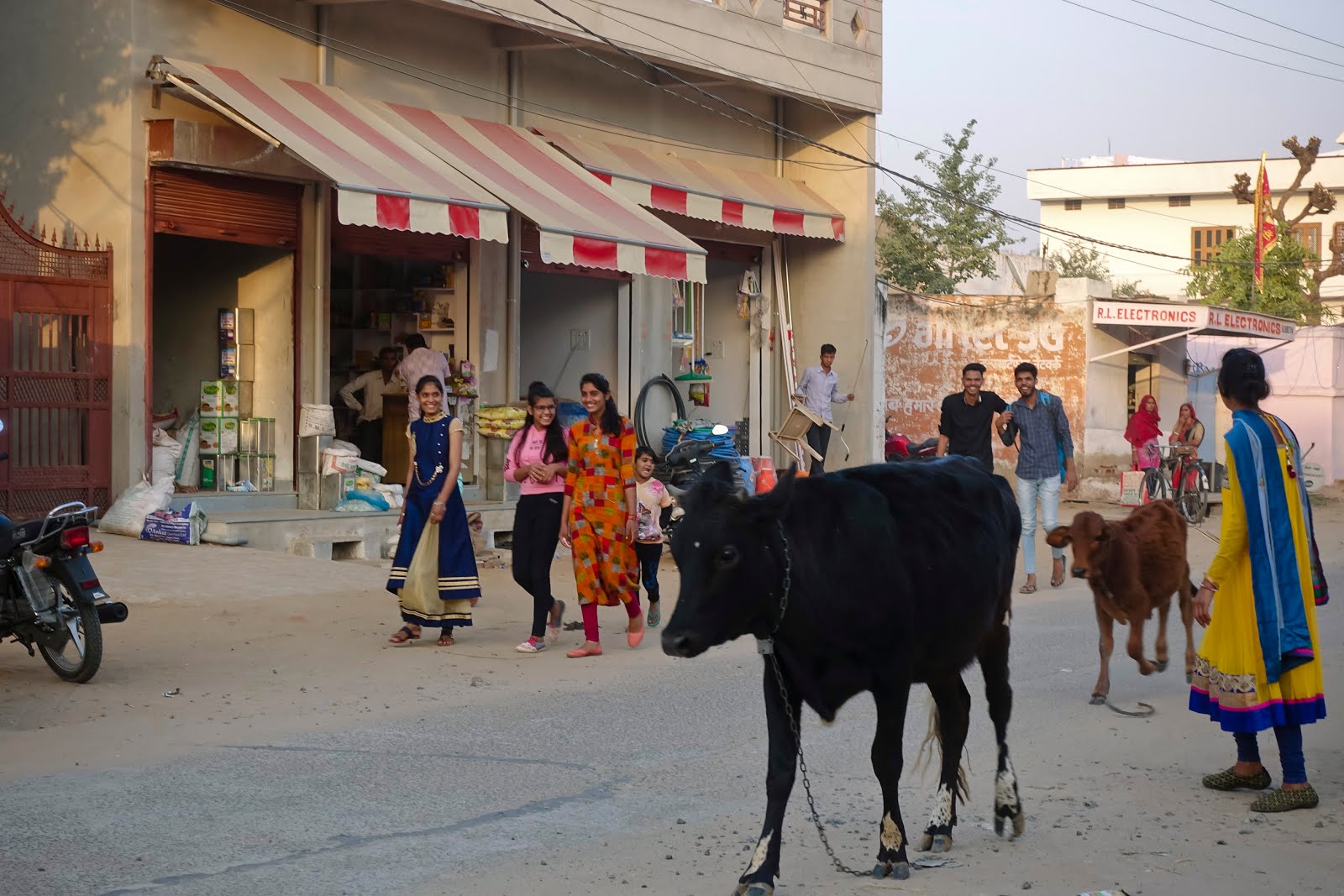
Chandelao girl - she chased me to be in my photo!
Chandelao parrots by the pool

The plan is to chill out here, so we have no outings planned, although we have heard that there may be more wedding dancing tonight. We walk in the village, I catch up on journal and photos, we read and nap and have a swim in the pool, where there is a bare tree full of green parrots - gorgeous. I also wander over to Sunder Rang, a women’s art collective next door, which is affiliated with Chandelao Garh - I settle on a khurta with a quirky bird print and a colourful string of red stuffed birds for a xmas decoration.

I’m beginning to like the ramshackle nature of this quirky place, and love the feeling that we are contributing to the maintenance of a heritage building that may otherwise crumble, as so many others have. And we are able to see a village community that without tourist facilities would otherwise be inaccessible to us. Tonight we take drinks to the (ramshackle) terrace, which has (quirky) glass-topped tables with tree root bases. Dinner again underground, as another large group (cyclists!) has arrived. It’s good to see that this place is thriving, at least in the cooler months.

After dinner we follow the sound of music to the wedding house, which is behind the one we visited earlier. The music is loud, but it’s a small and intimate family party, and while they are happy to see us, we feel that we are intruding and don’t stay long. No dancing tonight.

Our room, opening on to the lower terrace
Ramshackle upper terrace - with Kingfisher beer
Chandelao Garh main building
Chandelao village, sunset

Jodhpur

A car is ordered, the bill is paid, and we make the short one-hour hop to Jodhpur, the Blue City. We have to take a tuktuk to our guest house in Navkichoya, deep in the old city, but just a five minute walk to the Fateh Pol gate of Mehrangarh Fort. This afternoon we rest again, Chris still feeling unwell, and just take a short local walk at dusk. Lovely crumbling, or restored and painted, old houses. The blue everywhere (and green, mauve, orange). And everywhere the rubbish - sadly, it stinks. Dinner is at the rooftop restaurant of our guest house - lovely outlook (above the street smell), food just ok.

We arrange an early morning Blue City walk with Avi, our guest house host (deputy manager?). It is cool and lovely and at least some of the rubbish is being cleared. Avi has close connections to the neighbourhood and is involved in a small private charity to assist the community. So it is not surprising that his tour has a social justice tinge. He speaks disgustedly of local public servants and politicians who are happy to take a salary and do nothing, and he shows us the crumbling ruin of the local public school where, he claims, teachers are paid to teach, but no teaching happens and no-one ever checks. ‘You should be in politics’, I say. 'Then I would have to become a politician!’, says Avi. He shows us and talks of the heritage and history and community of the neighbourhood, and we don’t go near any markets or shops or the commercial centre of the city. This would not please everyone, but I like it.

Jodhpur rubbish
Mehrangarh Fort at dawn, from our room 
Blue blue city
Siesta during the warm afternoon, then a twilight shopping trip. The market area is the usual mad maze, so I pinpoint a couple of shops and rely on Google Maps - surprisingly accurate in this labyrinth. Sambhali is a charity craft collective for textile-based goods, but it turns out to be tiny with a modest collection of wares, I buy only a rather overpriced printed cotton scarf. The next, Maharani Art Exporters, a large fabric and craft emporium is the opposite extreme - floor after floor of goods stuffed to the ceiling, a dozen enthusiastic salesmen and few customers. I am overwhelmed and don’t hang around, especially as I don’t really have a clear idea what I’m looking for. Blingy Rajasthani embroidery with velvet, beads, mirrors and sequins, made up into patchwork pieces is prevalent and popular, but I find it a bit kitsch. My taste runs more to humble wood block prints. 

Walking home, away from the tourist area I see a small kitchenware shop with odd looking implements of wood and stone and terracotta. I could hang around here for a while! But have promised Chris I will be back for cocktail hour so quickly grab a small grinding stone - 70rp ($1.40!) - now that’s my kind of souvenir. Hurrying on, my way is blocked by a wedding parade, so I stop and climb up for a better view. The groom on a white horse is weighed down with garlands and looks weary as his celebrants cavort around him, handing out sweets. The horse doesn't look too thrilled either. And this is just the beginning of the ceremonies! 

Kitchenware shop
Twilight in the old city
Street food wallahs, Jodhpur
We have been told that today is the beginning of ‘auspicious wedding season’, as advised by astrologers, and we may see a few more weddings. So when I get home, after a couple of sunset cocktails, we are out wedding-hunting. Heading back towards the old city centre, we see plenty of people hurtling about in their finery, but fail to spot an epicentre of celebration. Until - jackpot - another procession: brass band, drummers, dancing family, friends and well-wishers and finally, the patient groom, laden with marigold wreaths, on his patient white horse. We follow for a while, but finally get too hungry and head back to dinner at Jeemrana veg restaurant, close to our guest house. The rooftop terrace is gorgeous, we order two curries which somehow both turn out to be creamy veg dishes (always difficult to get enough variety when just two of us) and some beer. Then bingo! another wedding procession passes by and we have a bird’s eye view this time.

Roll home, stuffed again, and lying in bed hear drumming getting louder and louder - we dress again and go back down just in time to see yet another groom and procession passing the door of the guesthouse, squeezing along the tiniest laneway! Yes, it’s been a big wedding night.

Wedding parade 1
Wedding parade 2
Wedding parade 3
Our last stop in Jodhpur, that we have been gazing upon from our room for the last two days, is Mehrangarh Fort. We get there early after checking out, and already tour groups are pouring in, but it’s a nice time to be here in the cool morning. It’s one of the most impressive forts in Rajasthan, a combination of atmospheric architecture and informative, historical museum and gallery. While I usually forgo the option of an audio tour, in this case it is included in the ticket, and is a very worthwhile guide to the place and its history. We have allowed 2 and a half hours, and it is barely long enough. The only disappointment is the number of the lovely miniature paintings currently out on loan to a travelling exhibition in the US - they are replaced by prints, some of which are good quality, but others rather poor. 

Finally we head back to the guest house for our drive to Ghanerao, another heritage stay in a village for which we have great expectations (recommended by our friends Martin and Deborah). It's another one of those drives that looks as if it should take less than two hours, but takes well over three, as the main inter-town routes change to potholed village throughways. It’s a nice idea that with a private driver we could ask him to take detours for a more scenic route, but … it’s impossible to tell the state of the roads from the map, and really we don’t want to spend even more time driving! We stop for lunch on the way at a basic ‘dhaba’ - open-air truck-stop. Luckily our driver is happy to order for us, as they seem quite nonplussed by our presence. We get some dal, a veg curry, and roti, and it’s so delicious - the spiciest food we have had so far. We share between the three of us, and the cost is less than $5, which I’m sure includes the ‘tourist’ surcharge.

Beautiful jaali at Mehrangarh Fort
Glam tourists at Mehrangarh

ANIMALS

Dog and pup in rubbish, Jodhpur

Cows, dogs, monkeys, squirrels - all of these roam wild, and are communally cared for (yes, we even saw squirrels being fed!). An iconic and wonderfully metaphoric image that I brought home from my first visit to India is that of a sacred cow lying in a rubbish heap: they are still there. Today in Jodhpur I found a dog and her pup sleeping in rubbish.

Asking one of our drivers, it was good to hear how the cows are communally fed and milked and the proceeds used to support them. But it’s hard to see the point of the other animals who are messy, and a pest, and may be diseased, yet are fed and encouraged to breed.

Hinduism in it’s purest form is vegetarian and deplores the killing or mistreatment of animals - after all they are reincarnated souls - so animals are treated as sacred and cared for*. However, sacred cows may be abandoned when past their productive life and certainly we see many in poor condition, and dogs that appear to be malnourished and neglected. While it seems so perverse, is it any more crazy than western culture’s conflicted treatment of animals for consumption vs animals as pets?

*Nazim, our Delhi driver, tells us he is vegetarian because he loves vegetarian food. And so is his family. And also, by the way, the Bhagavad Gita says you will go to hell if you eat meat, so you should stop now! 

Thursday, December 13, 2018

Jaipur - forts and food

See the whole Photo gallery here.

We pick up drivers as we go, and they are a mixed bag. There is the good of supporting local drivers, but many of them have poor English. And they don’t necessarily know the local area well from a tourist point of view. Our driver today is the same one we had for our Shekhawati tour yesterday; he was rather taciturn, but a good driver, and the car has AC - important on these dusty roads, as Chris still has the cough he picked up in smoggy Delhi. When we arrive in Jaipur I have to direct him to the hotel using Google maps on my phone. So few drivers seem to use GPS, rather stopping as we near the destination to ask local bystanders for directions.

I have mapped a convenient shopping walk near to our hotel, and plan to do this while Chris rests. But he decides to come with me, and as this new city area is not so interesting for a non-shopper, we go into the old city instead. Starting at New Gate, we are on a road of local shops - textbooks and spectacles - but we are encouraged to venture into the back streets for the ‘silver market’. Bad idea - we are soon completely lost in tiny alleyways infested with loud, hooting and fast-travelling motorcycles, and it’s no fun being a pedestrian. Heading back to the main road, we try to spot the Pink City central landmark - the Hawa Mahal. But where is it? All is chaos. The large Badi Chopar square is a dug-up construction zone surrounded by tall hoardings, and the traffic is funnelled into one lane surrounding it, almost on top of the sidewalk shops and stalls. Turns out they are constructing the final stations of stage 1 of the new Metro project. Jaipur traffic is crazy at the best of times, and if any city needs a metro system it is Jaipur, but meanwhile - madness. Finally the familiar honeycomb of Hawa Mahal looms, we take a couple of quick photos, and get out of the chaos as quickly as we can.

I do manage a quick shop at the large Anokhi outlet here (some of my friends will know it’s one of my favourite shops in India), and we find an ‘English wine shop’ to buy a bottle of local wine to drink on our hotel room balcony, looking out on the hotels and tuk tuks across the street. It’s ok, but at $22 for the cheapest bottle, it’s hardly a bargain (good local whisky can be had for $12). At dinner in the rooftop Peacock restaurant we have Afghan tandoori chicken as respite from our recent vegetarian diet, it is delicious!

Musicians at the Peacock Restaurant (rooftop of Pearl Palace Hotel)
Jaipur
Only one day in Jaipur, so we ignore the great plans expounded to us by all the tuktuk drivers who would wish to spend the day escorting us to dozens of locations. First - Jantar Mantar and City Palace, and early in the morning it’s a quiet and relaxing drive to the old city, as shops are all closed.
Jantar Mantar, a garden full of amazing mathematical/astronomical instruments built in the early 18th C by a Rajput ruler, looks like a Bauhaus playground. It’s busy with mostly Indian tourists, but keeps us entertained for a couple of hours.

City Palace next-door looks like a film set, according to Chris, as if it’s constructed from plywood. We know it’s not, but this comment colours my perception, as do the numerous officious security guards checking tickets, are we walking in the right direction, forbidding photos, etc. Our favourite place - the large reception hall (Diwan-i-Am) is lined with images and fascinating stories of the Maharajahs (no photos!). We decide to forgo the (very pricy) tour of the Royal Apartments, still occupied by the erstwhile Maharaja's family and head to the Amber Fort, 11km north of the city.

Bauhaus sculpture garden at Jantar Mantar
City Palace, Jaipur - looking like a film set
Lovely Peacock Gate and lovely tourist at City Palace
The tuktuk drive out is fine, and we brave the walk up rather than wimp out with a jeep ride. I love this place, such a contrast to the Palace! Huge, solid, crumbling, rambling, with little signage, and is restored enough to be safe (by Indian standards!) but still quite crusty and very atmospheric in spite of hordes of visitors. It’s lovely to make your way to a remote pavilion, and spot over there a courtyard you haven’t seen, and like a treasure hunt find your way there. And there are the mosaics, the marble jaali (carved lattice screens) ... We stay until the sun is setting, then find another tuktuk to go home. The price seems to have gone up … and we can see why - the traffic through the old city is the worst yet!

Back at the hotel, we brave a 5-minute walk to the nearest Wine shop for some beer. ‘You just have to cross the main road and there it is’, we are told. Yes, well ... see story on DRIVING.

Labyrinthine Amber Fort
Gorgeous marble jaali

Away from it all in Kharwa

Today we drive to Kharwa Fort - we have decided on another out-of-the-way stay rather than brave the famous camel fair at Pushkar.  We will go via Kishangarh so that we can check out the lovely old hotel at the Phool Mahal Palace; encouraged by some Tripadvisor reviews, we plan to have lunch there before traveling south to the Kharwa Fort Homestay. We have become aware already that there are looming elections in Rajasthan, political rallies are numerous, and here is one on our way into Kishangarh. There is no traffic management for these large rallies, and the normally difficult roads become practically impassable. Many side street detours, and much loud horn blowing later, and we reach the Phool Mahal Palace. It is deserted, no-one even at reception. Finally the hotel manager appears, and looks nonplussed - Lunch? I’m sorry you would have to book and order ahead … Perhaps - a cup of coffee, and a sandwich? We gratefully accept, and he hurries off.
We wander round and explore the place, lovely setting and dining room - but it looks as if there are few if any visitors so the kitchen/dining area is not in action. After 30 minutes - instant coffee, and a grilled cucumber sandwich. It is not the guided tour of the palace that I had dreamed of, but we won’t starve!
Leaving Kishangarh, the traffic is even worse. It becomes obvious why larger vehicles take precedence - if not: gridlock. We finally reach Kharwa Fort mid-afternoon, and our very patient driver gets a tip for the Kishangarh hassle. Kharwa is a small village, quite close to the main road from Ajmer, and the industrial outskirts of Ajmer are creeping closer to this tiny rural place.
Waiting for cucumber sandwich at Phool Mahal, Kishangarh
Kharwa Fort
Our gorgeous room at Kharwa Fort Homestay

Wow! Kharwa Fort is interesting! It has been in the same family for five centuries - 18 generations, now divvied up into the private quarters of five brothers, and their families. Jyoti, our hostess, is married to one of the brothers, Shyam, and her sister and daughter are also visiting. It’s a real homestay - there is just one (enormous) guest room, with a temple behind where we can hear the singing and drumming of ceremony. We are invited to spend time with the family, taken to their farm, a short walk away, where villagers cultivate the fields as if nothing has changed in 500 years. We drink masala chai with sweet biscuits, and chat. They are an old aristocratic family with well-educated daughters who have professional city lives, and have no clear idea of how the ancient heritage will be managed into the future.

Later we share a drink (whisky and water) on the terrace with the old bloke. He is a big gruff fellow with giant Rajasthani moustache ,and seems to feel out of place in the contemporary world, with his modern women. I had expected an extensive apartment with a manservant and cook, but their quarters are modest and it is Jyoti in the kitchen. Quite a large space is sacrificed  for the homestay. Dinner is home cooked non-veg thali, and is delicious. And for breakfast  - anda bhurji (spicy scrambled eggs - my new favourite) with paratha and home-made pickles.
In the morning we explore the small village. The turbans here are the largest so far! Once again we are the only tourists and the centre of attention. It’s quite entertaining, at least for a short while, being the entertainment.
Kharwa village
Chris with friends - Kharwa
The old lady is blind - but insisted that we photograph her

FOOD

Kharwa breakfast - anda bhurji with paratha and curd

* Disclaimer: I am a proud foodie! But almost never photograph food, too busy eating it ;)
As we are largely eating in tourist guest houses and hotels, it's quite hard to get anything really spicy. Rajasthani cuisine is in any case on the mild side for India. But you can always ask for pickles on the side. People seem quite amazed when we tell them that we love spicy (hot) food, and cook it for ourselves at home. Vegetarianism is very prevalent, being intrinsic to the Hindu religion, and restaurants that do serve meat often have non-veg meals relegated to a page at the back of the menu. Some places we stay are vegetarian only, although I understand that they can procure meat dishes if requested, as well as alcohol, although that's not on the menu either.

At the heritage stays, where it is a set menu for dinner, there are very tasty, fresh home-cooked meals - usually a dal and 2 or 3 veg dishes, one potato-based, sometimes a non-veg dish too, served with rice and roti. It's very difficult to fit in the dessert! While fruit platter with toast and eggs/omelettes are staples of the breakfast tables, it's definitely good to choose Indian breakfast if available. My favourite being stuffed paratha (flaky bread) with curd and pickle, but poha (savoury dish with flattened rice) and upma (savoury dish with semolina) are also delicious*. After large yummy breakfasts and in expectation of large yummy dinners, we mostly lunch on a lassi - plain sweet, mango or rosewater - the nicest we have is in Udapiur and is flavoured with cardamom.

While I like to believe I am a street food aficionado, here we largely avoid it - well, we are usually walking around so well-stuffed already. And we are wary of bugs, so prevalent here. On one of our last days I slip up and buy some food at the railway station. By the next day Chris is ill, and two days later so am I  :(

* Given the current baby boomer trend to refuse grandma and grandpa as honorifics, I decide that Chris and I will be Poha and Upma if the opportunity arises.

Saturday, December 8, 2018

Shekhawati - driving and dancing

See the whole Photo gallery here

DRIVING 

is in a miasma of dust and pollution. The roads vary from multi-laned highways to one-laned potholed backstreets, and in the 'old cities' tiny laneways that barely fit a rickshaw, let alone a car. Major routes between towns may be just one potholed lane filled with wandering cattle. But the rules remain the same - the largest vehicle rules. Horns are the main instrument of communication: 'I am here, let me through!' Indicators are rarely used, and seat belts generally not operational - it is hardly surprising that India has a poor road safety record. As a pedestrian, one is at the lower end of the pecking order, pedestrian crossings are completely ignored. The method of crossing a large road is similar to what we have found elsewhere, eg in Vietnam: wait until the traffic is mostly composed of motorcycles, then walk into the stream and let them flow around you. But some of them are so aggressive! It's not for the faint-hearted, and on a few occasions we are assisted by sympathetic locals. In the middle of all this are wallahs with handcarts, families on motorcycles (she with trailing sari and babe in arms), young children on bicycles, and a variety of pedestrians - madness!
On the road ...
Delhi to Shekhawati

To save money we organise our own driver to Bagar in the Shekhawati district. He is the son of a driver/guide we met yesterday, but today he has decided on a longer backroad (Google says it is faster) so the price goes up ...
Off we go, 24yo Nazim eager to tell us what a great driver he is, how much he loves driving, and that his father has warned him to 'Go slow! They are seniors!'. He doesn't go very slow, and loves to careen across 6 lanes while checking out Google maps on his phone.
For the first couple of hours getting out of smoggy Delhi, through a hellish landscape of industry and construction rubble, the smoke and dust get worse. Could we please have windows closed and AC on? Oh sorry, no, that will use too much fuel, we haven't paid for that!
As the journey continues, Nazim becomes more and more irritated.
This is longer than he thought! The roads are bad! (it is true, but it was he who selected this route).
The tolls are very expensive! (he argues with each toll collector).
Why do you want to go there? There is nothing there!!
Do we want to stop for lunch, he asks?  No, not really (we would like this drive to be over with!).
Nazim gets even more agitated. It turns out that he has had no breakfast and is starving. But we are happy for you to stop for lunch! No, I can only stop if you are also going to eat.  OK! We will stop and eat!
Finally, only 20 min from our destination we find a restaurant that is 'clean' enough for him. We order a couple of stuffed parathas - they are delicious! Nazim, on the other side of the restaurant, orders a table full of food. When we meet him outside, he is once again agitated - What's the problem now? You didn't pay! But we did pay ... You didn't pay for me!!
We move on and soon, with relief, reach our destination. Nazim is happy to accept our 6000 rp, plus 200 ($4) for his lunch. He is in a much better temper now, and so are we.

Piramal Haveli and front garden
Gold Room at Piramal Haveli
The Piramal Haveli is a gorgeous, early 20th C, crumbly and characterful building, originally a merchant’s house. Now inherited by two brothers, one half is used as accommodation, the other sadly left to crumble. There are two courtyards, large front garden with trees, flowers and lawn; back garden with dust and peacocks. We seem to be the only guests (there are 8 guest rooms). We book for dinner then go for a walk in the largish village - donkeys, camels, sari-clad women peeking from beneath their veils, school kids - everyone smiling and happy to see us, seems we are the only tourists in the village!
Dinner, with strong Kingfisher beer that charming Ajay (assistant manager?) has procured for us, is a delicious veg thali, and we are comprehensively stuffed.

We are here for a rest after a tiring four days in Delhi, so morning walk after a large (yummy!) breakfast, skip lunch, afternoon walk to local temple - a new construction on a large rubble-filled ground, not so attractive, but the sunset colours are lovely and so are the local people. Can’t for the life of us work out where to buy beer, but we do find some cold juice for our vodka cocktails on the porch. Ajay is cooking tonight, and the food is even better! Baby eggplant curry, and a green bean curry are wonderful.

Friendly locals in Bagar village
Ajay serving breakfast in the main courtyard
For our final day we hire a driver for a tour of the region - to Jhunjhunu, Nawalgarh and Dundlod for various temples and havelis. At the Rani Sati temple in Jhunjhunu (controversial, as it celebrates an act of Sati, or widow-burning) we are invited by a teenage girl to accompany her middle-class family from Mumbai. Here on their holidays they can see we are out of our depth! The main temple is spectacular, and kitsch, as only a Hindu temple can be - and there is beautiful puja (ceremony) happening involving fingerpainting with henna and water before the main shrine. But no photos :( Then to Modi Haveli, which we find after walking up and down the marketplace a couple of times. There are painted walls everywhere! But only a few of the dozens (hundreds?) of old painted havelis are open to enter.

Next is Dundlod, a village near Nawalgarh, where we visit the dusty old fort. Just a few rooms open and it’s as if they haven’t changed (or been dusted) since the family moved out a few decades ago - the spooky sense of a habitat left almost undisturbed. They have no change for our 100rp note (a common plight in India!). Nearby, the Satanaryan temple, around a century old, it is also dusty and somewhat decrepit, and we wake the temple guardian from his nap. Showing us around takes two minutes, it is tiny, and I offer him a 100rp note for his trouble. But it is torn and he can’t accept it! (another common plight), so I replace with a new one. Then - Goenka Haveli, quite impressive, and the guide is a dab hand at taking photos. He gets another 100rp note. Finally Nawalgarh, and the Havelis here are really amazing, as they are not only very intact, but also set up as museums to assist in understanding the history and lifestyles of these families. Morarka Haveli Museum, and Podar Haveli Museum are the ‘must-do’ locations in this area, the second in particular is amazingly restored, has a fabulous guide, and multiple museum rooms of more or less interest - silverware, ceramics, marble sculpture, regional wedding garb, regional painting styles, models of forts and palaces … and much, much more. We cannot see it all, but leave feeling very satisfied.

Sacred kitsch at Rani Sati Temple
Spectacular Poddar Haveli, Nawalgarh
Back at Bagar, Raju, the PH manager, says that there’s a festival tonight at the new temple, so we go for a walk. When we arrive the Bollywood Disco Van (that we have heard around the streets on other evenings) is in full swing with women dancing around. They immediately grab me and drag me in to dance. It’s fun! Until I look around and see that I am the centre of a large circle of people with phones out, recording my performance! OMG. I am dragged here and there for dances and selfies until I manage to drag myself away - let’s get outta here!
I decide that Hindu is probably, at least superficially, the most fun religion - they love to sing and dance, and the temples are all decorated as if for Christmas!

Checking out in the morning we tell Raju that we visited the temple. ‘Yes, I already heard that you were dancing!’ he says. ‘That’s why I have to leave town now’, I lament. Ajay chuckles.

Dancing at the temple, Bagar
Chris and friends, Bagar village

Delhi - Diwali and qawwali

We have already finished our trip and my first post is finally here! I have so many notes and images, and will slowly get them posted :) See the whole Photo gallery here.

Hauz Khas Village

We fly AirIndia as it is direct to Delhi, and the flight is totally populated by Indian people - we almost feel that we are there already. When we see decorations at the check-in counters we think they are celebrating Diwali, which is tomorrow, but then we see decorations all through the check-in hall, it is for Christmas, almost 2 months early!

Hauz Khas Village (southern Delhi) is a historic village dating back to the C13th next to the old water tank (lake), madrasa (Islamic college) and tomb monuments of a Mughal enclave. In the 80s it was renovated and since then is reputedly transforming into a trendy upmarket area with bars, boutiques and antique shops, and to a degree this seems true. At night the main strip is a dive of bars, fast food and suburban youth looking for fun, In the daytime hip middle class girls come in for some edgy shopping. And there are many fancy wedding-wear shops. But always very close are the slums: we walk in and feel like aliens. Not a tourist, or any middle class person. The old community houses give way to shanties and the crumbling streets to piles of rubble. They wonder what we are doing here, and so do I.

HK Village when we arrive in the evening is reminiscent of Kings Cross, full of bars, clubs and boisterous young men. Not quite the boutique arty haven I anticipated. And Chris has been expecting something more upmarket than our slightly shabby Airbnb apartment. But it's spacious, and right on Hauz Khas park. Trees obscure what would otherwise be a fabulous view from the balcony, but it's very pleasant. We find a ‘south Indian diner’ and eat dosas, very cheap but no beer :(
The 'tank' at Hauz Khas Park
Slum girls - Hauz Khas village

Diwali

We wake up early to monkeys and squirrels on our balcony, and apparently there are also deer  in the park ... today we head to Qutb Minar complex and Mehrauli Archaeological Park.
Q Minar is already busy, but it's an impressive site, the tower itself surprisingly awe-inspiring, and the mosque facades with red sandstone carving are gorgeous. A lovely thing is the green parrots nesting in crevices (we realise later that these are everywhere). The crowds of Indian visitors who arrive are largely dressed in Diwali finery, so it's all quite colourful.
Walking to Mehrauli Archaeological Park nearby, we encounter a street full of flower sellers with orange and yellow marigold garlands - traditional Diwali decorations. Not everyone gets a day off for Diwali. The large, free public park has no tourists in sight; a few wanderers and some rather bored security guards having to spend their Diwali here. It's the site of one of the ancient settlements in Delhi - monuments are in various states of decay, sometimes charming; sometimes sad, with strewn rubbish.
Back in HKV shops are all closed for Diwali - so we wander around the village, and find local ladies taking Diwali offerings into the surrounding slums. Late afternoon, the local archeological park is buzzing as surrounding houses turn on Diwali lights. The tombs and madrasa are picturesque in the twilight, and so is a multicoloured house alongside the park that looks like a slumdog millionaire movie set.
We're invited to a local guesthouse for drinks and fireworks. They have a view over the park which, like ours, is obscured by trees. A few fireworks are starting - the government has legislated that they will happen between 8-10pm, we shall see. Our host arrives with an esky, turns the light on, and a few guests wander in as we sip generous G&Ts with mint, no ice. But we are feeling Sydney time, past 2 in the morning, so as the fireworks fire up, we head home to bed.
Gorgeous red sandstone carving at Qutb Minar complex
Garland sellers, Mehrauli - "hey! take my photo! with flowers!"
Multicoloured house - Hauz Khas Village

Delhi, after Diwali

We have managed to sleep through the noise, but as predicted the smoke/smog this morning is truly awful, we can barely see the park beyond the trees. Delhi is already one of the most polluted cities in the world, so it is really quite hazardous. We breakfast at L'Opera, a gorgeous French patisserie just around the corner - quiche, croissant, latte - really delicious. Then another walk in the archaeology park, foggy and atmospheric. A last quick walk around HKV, as shops are opening, then off to Nizamuddin East.
GG B&B is a very nice house in a very nice neighbourhood (gated suburb), operated by a long-resident Nagaland family, and the rooms have air purifiers!
After lunch at Turtle Cafe, over the main road to the crazy labyrinth of Nizamuddin West for (hopefully) some qawwali music at the Dargah of Nizamuddin Auliya. Previously we have been so fascinated by the otherness of this place. But wow, the crowds are stupendous - long queues to get into the shrine, nowhere to stand, let alone sit, no sign of qawwali except for one lone random singer in the midst of the crowd. Once again wonder what we are doing here, so we head home early.

Smoggy Hauz Khas park after Diwali
Crazy crowds at Nizamuddin Dargah

Delhi qawwali

Next day we want to try again for Niz Dargah, but in the morning 'pop in' to Humayun's Tomb. Choosing to walk via back streets, rather than the main road, we are followed by a persistent street dog, who spends the walk defending us from all other neighbourhood dogs. It's a noisy walk! Still smoggy today and H. Tomb is very atmospheric. One does not 'pop' here, but wanders slowly through enchanting vistas. The site has been progressively upgraded over the past several years, and is looking lovely, if dusty. If only all the water courses were running ...
As we leave we see signs for a new archaeological park - Sunder Nursery is just over the road, and free entry for now. The main area is very smart, and has a couple of beautifully restored small tombs, with intricate plaster carving. Further out it is still quite wild, with monuments in various stages of restoration. As well as a park, there is a nursery for cultivation of local flora, and habitats for fauna and birdlife, but we are too tired to explore it all.
After midday rest we head off again to Niz West, this time with a Plan B - qawwali at Inayat Khan Dargah*. It's Friday - holy day - and Nizamuddin Dargah again seems very crowded so we don't even try to enter, but head 'straight' to Inayat Khan, which we find after walking in several circles. At 6pm we are beckoned in as qawwali is about to start, and find ourselves the only audience to the four seated musicians. Over the next 10 min or so several other westerners wander in. What a difference to Niz. Dargah just down the road! It feels a little awkward but the music is enchanting. One by one each of us rises to make an offering, and after 40 min it is over and we hurry out to Karim's for a mughal dinner of mutton curry and dal. Finally satisfied with music and food, we head home for an early night.
* INAYAT KHAN was a westernised Sufi saint who lived most of his life in Europe and was responsible for the spread of Sufism internationally. His shrine is in an elegant modern building, a lovely oasis in the chaos of Niz W. No photos allowed :(
Humayun's Tomb in Diwali smog

CLOTHING

Women in salwar kameez, taking Diwali offerings to a shrine in the slum - Hauz Khas village
While India is very Westernised in many ways, especially in the city, traditional and indigenous clothing is still quite prevalent, especially for women. At some historic monuments where there are large numbers of Indian tourists it can be very picturesque, with women dressing and adorning themselves as for a special occasion, sometimes in traditional saris, or often the more modern 'salwar kameez' - both beautiful and practical. It's a struggle keeping the dowdy men out of the photographs. Lower-caste women such as sweepers and road-workers are arrayed in startlingly bright traditional saris - pink is especially favoured as being a sacred colour. Such elegant wear among the rubble, dust and rubbish.

Monday, November 5, 2018

Rajasthan revisited

It's been over 6 years since I first, briefly and tantalisingly, visited Rajasthan (northern India), and swore to return with Chris. At last we are about to set off.

It's more than 11 years since I first used this blog to journal our overseas travels (Europe 2007). In the age of Instagram, Facebook and WhatsApp it seems rather a retro thing to do, but in the interest of consistency (and because I still hate taking photos on my phone), the adventures of our Rajasthan trip will be recorded here for posterity :)

Below is the map of our planned route. See you on the way!

UPDATE! Photo gallery