Tuesday, August 22, 2017

Japan: Honshu 2 - Yamagata & Nikko

19 July - Yamagata

Lovely Yamadera
We leave early from Hiraizumi and arrive in Yamagata at 10.30am. but pickup/check-in for the guest house is not available until 3pm, and it’s too hot to walk or explore the city. Yamagata has NO signs in English, seems Yamagata is not much of a tourist town ... but the girl at the tourist office is very helpful. We hop on a bus to Hirashimazu, suspiciously eyed off by a horde of young children who are not accustomed to seeing 'gaijin'. Hirashimazu is supposedly (Lonely Planet) an enclave of potteries in an outer-town village by the river. We arrive. It’s hot, not a pottery in sight, just a post office. We walk along the river towards the hills - nothing. Back to PO and PO girl tells us that our route was correct but we didn’t walk far enough. <Sigh>. We try again and after 15 minutes find an open general store where we are directed to the ‘brown house’ nearby. There’s a large-ish pottery shop, but no sign of a working pottery, demos from the master or lessons available … we buy a few small bowls (seconds - artisan pottery is so expensive!), and they offer us tea and snacks. But no - we must catch the bus back and head back to town.


Children boarding the bus
Train to Yamadera

20 July - Yamagata/Yamadera

Today is the ‘day of 1000 cuts’ according to Chris, who believes that ascending to the Risshaku-ji temple on the mountain-top at Yamadera on such a hot day will be the death of him. We start early and take plenty of water, and I carry the pack. It is a quick (15 minute) and lovely train ride, and the town is quiet and cool when we begin the climb. The lower part of the walk is beautiful and shaded, and the steps are shallow and easy. Every few minutes is a glade with statues, mossy rocks, lanterns and a tiny shrine. It’s gorgeous. We make it to the top in just over an hour, and it’s by now sunny and hot. We buy a little picture book of the travels of Matsuo Basho. A poet and Buddhist who became a pilgrim and promoted Zen Buddhism through his prose and haiku. He is a cult in these parts. Most renowned for ‘The Narrow Road to the Deep North’, he wrote of Yamadera: “Stillness, seeps into the stones, the cry of cicadas”. Of Hiraizumi he wrote: “Summer grass, all that remains of warrior dreams”. But the stillness is now invaded by many more tourists on the ascent, so we hurry back down.

Yamadera shrine
Matsuo Basho, cult poet
Intrepid climbers, another Yamadera shrine
View of Yamadera from the top
Basho again ...
I have been hankering for a sushi picnic, since missing out in Hakodate, so we go to ‘Family Mart’ to pick some up, but the choice is not so good. Anyway, it’s now very hot, so we opt for the cool of a soba noodle place at the station. It’s air-conditioned, and the soup is good, with lovely chewy noodles. Now - walk home via the ‘City Museum,’ located in an old weatherboard palace of a building that used to be a hospital (Miyazaki again!). But it’s too hot to really enjoy the weird collection of exhibits (old hospital machinery and instruments, woodblock prints illustrating various ailments including pregnancy), so we soon melt off home. When we get back to the guest house, a sizeable choir is practising their harmonies in the kitchen/dining room. Gorgeous!

We ask advice about a restaurant for dinner, and have three otions: nearby rice bowl place, slightly more distant a ‘bit dirty’ downmarket fish place, and further again, a more upmarket ‘typical Yamagata’ restaurant. We try for the fish place - it’s upstairs at a shabby old fishmonger’s shop, and is probably great, but the host has no English, or a menu, so (to his relief I expect) we thank him and leave. The ‘upmarket’ place is not far, so there we go. It’s in a converted warehouse, restored in a retro kind of way, cool and with dark wood trims and furniture, and the set price is reasonable (about Y1800 - $22). The food is beautifully presented - bits of sushi, pickles, noodles, soup, fish and meat on various lovely plates - a grazer’s dream. But the atmosphere’s a bit lacking: we are the only customers in the ‘western’ room, and the lights are a bit too bright.

Miyazaki style museum
Medical woodblock print

21 July - Yamagata-Nikko

A lift to the station - it’s a nice walk, but hot with luggage - and wait for the train. Chris manages to cause a stir when he presses the wrong button in the toilet and alerts security. Those Japanese toilets ... (also see Japan OTT).
In Nikko, I quickly begin to wonder - ‘Are we still in Japan?’. The guesthouse has not answered my email about providing a shuttle from the station, and in the sister guesthouse by the station I am told, ‘Only between 3pm and 5pm’. ‘But it is after 3pm’. ‘Ah ok, I’ll call him’. 45 minutes later we are still waiting. 
We have been spoiled in northern Japan, where we are often the only western tourists in sight and have been treated as special. Here in Nikko there is a profusion of Western and other non-Japanese visitors, and much architecture is also quite European, it feels quite un-Japanesey.
Finally at the guesthouse, it is in a pretty, slightly remote spot, only 15 minutes walk to town, but quite steep. After delivering our luggage and checking in, we trot back down the hill to shop and explore. At least the weather here is slightly cooler, and damp. Town is unremarkable, except that it feels more of a tourist hub than anywhere else we have been. It’s day-trip distance from Tokyo, so not surprising really. We buy some supplies (sake, beer, and addictive squid crackers) and on the way back up stop at a park shelter with atmospheric mountain views.
Because the guesthouse is out of town we have ordered dinner to eat in. The place is rather shabby, and a bit grubby (so un-Japanese!), but dinner is fine - grilled salmon with cabbage salad, rice and soup.


Mountain views near guest house 
Selfies at Shinkyo Bridge, Nikko

22 July - Nikko

Some places exceed expectations, other disappoint. Nikko is the latter.
How annoying that we ended up here on a Saturday - the place will be packed! So we try to set out early to the temple sites, hampered by the fact that breakfast is not served until 8am. We hurry through breakfast and down to the bus stop, arriving at the temples just after 9am. It’s not too bad yet. I try to buy the recommended ‘combination ticket’ for the best value, but it’s no longer available. So we get a ticket that covers two of the half-dozen sites Taiyuin and Rinno-ji. The first is a small unostentatious temple with some lovely woodcarving, and set in a garden with hosts of stone lanterns. Much of the garden is unfortunately screened off as they are pruning the pine trees today. I complain to the ticket seller, as we had not been warned that so much of the site would be inaccessible. But the laugh is on me when we reach Rinno-ji. It took a while to find it - because it is being reconstructed inside a giant warehouse, and most of it cannot be accessed. There’s a fenced off view into the front chamber, than some temporary corridors housing some of the temple treasures. Not what we paid for, and I complain more loudly this time.

The lovely side of Nikko
Meanwhile the crowd for the main shrine, Tosho-gu, is getting larger, queuing in the sun. So - let’s head for the art gallery - a tried and true strategy to avoid tourist crowds. Following the signs, the gallery we find (Nikko Toshogu Museum) is in a brand new building (yes, Lonely Planet says that they have a new gallery building). It is quite expensive but cool and airy, so in we go. But soon I realise it’s a different museum entirely from the one I expected, focusing on the history of the family who built the shrine. Still, it’s informative and a nice place to spend time away from the hordes. Emerging at lunchtime into the heat, the crowds are even more crazy. We now find the road to the old gallery (Nikko Toshogu Art Museum) and it is almost deserted. The gallery is, after all, still in a lovely old cedar mansion, the former head office of the shrine, with traditional garden. It has beautiful examples of traditional and a few more contemporary screen and door paintings. It's quiet and serene, aah - feel as if I’m back in Japan.
Nikko tourists
The old-style Art Gallery with old-style visitor
Art Gallery garden
Door painting in Imperial residence
So we leave from the shrine area and head for less-touristed parts along the river - a large park and the Nikko Tamozawa Imperial Villa. Exploring a small temple along the way, just as we arrive at the park, the rain pours down. Aagh, no umbrella! But there’s a noodle shop! No, closed (but they do give us an umbrella). Then we spy a tea room! Sorry, closed. It’s not even 4pm. When we find the Imperial residence, it is still raining, so we might as well go in, it’s open for another hour. Traditional Japanese architecture is so soothing, we wander around the almost empty house and garden, with solicitous attendants offering snippets of information on the way. Definitely back in Japan!

It’s been an expensive (around $80 in entrance fees) and somewhat frustrating day, but we end it looking at the gorgeous mountain setting as we stop for a drink on our way back up the hill. In spite of the beauty, tourist-infested Nikko has not endeared itself.

Monday, August 21, 2017

Japan: Map and trains

I have been asked for a map to illustrate our route - so here is one with our main connections from Hokkaido to Fuji, and some of the locations marked that we visited. Click to see in Google maps.
How did we travel? almost exclusively by train.

TRAINS

On the train ...

On the train 2
Travelling in Japan must be done by train, unless in remote areas where services dwindle. For us, we do so even in remote areas, as Chris is not interested in driving in foreign places - even though they do drive on the left here! Fortunately the trains are fabulous - clean, fast, frequent and as regular as clockwork. With a railpass we even get to travel on the expensive Shinkansen (bullet train), but I prefer the inter city express trains, that have bigger windows, and still travel quite fast enough. I already talked about the very lovely eating-on-trains tradition, but did I mention the sleeping-on-trains tradition? A lot. Even on the subway.

Then there are the local trains, no reservations, and usually filled with schoolkids, salarymen, and women with shopping. They are efficient but not high tech - in fact in common with much of Japan, they are distinctly retro in style. This is when things slow down and it’s possible to take a few photos. The slowest train of all was the one from Osuki to Mt Fuji (Kawaguchiko) - almost one hour to travel 27 km! Very rustic …

Can’t finish with trains without mentioning Hyperdia, the amazing app that lets you plan train routes - with all times, connections and often even platforms listed. It even works on the Tokyo train/subway system - that is another kettle of fish (or can of worms …).

Rustic train and station - Takikawa in Hokkaido
From the (slow) train
Sleeping ...

The Shinkansen cometh ...
At the station - Yamagata
Local train to Nikko
Eating on the train
Station on the local Fuji line


Saturday, August 19, 2017

Breakfast, stamps and flowers ...

JAPANESE BREAKFAST

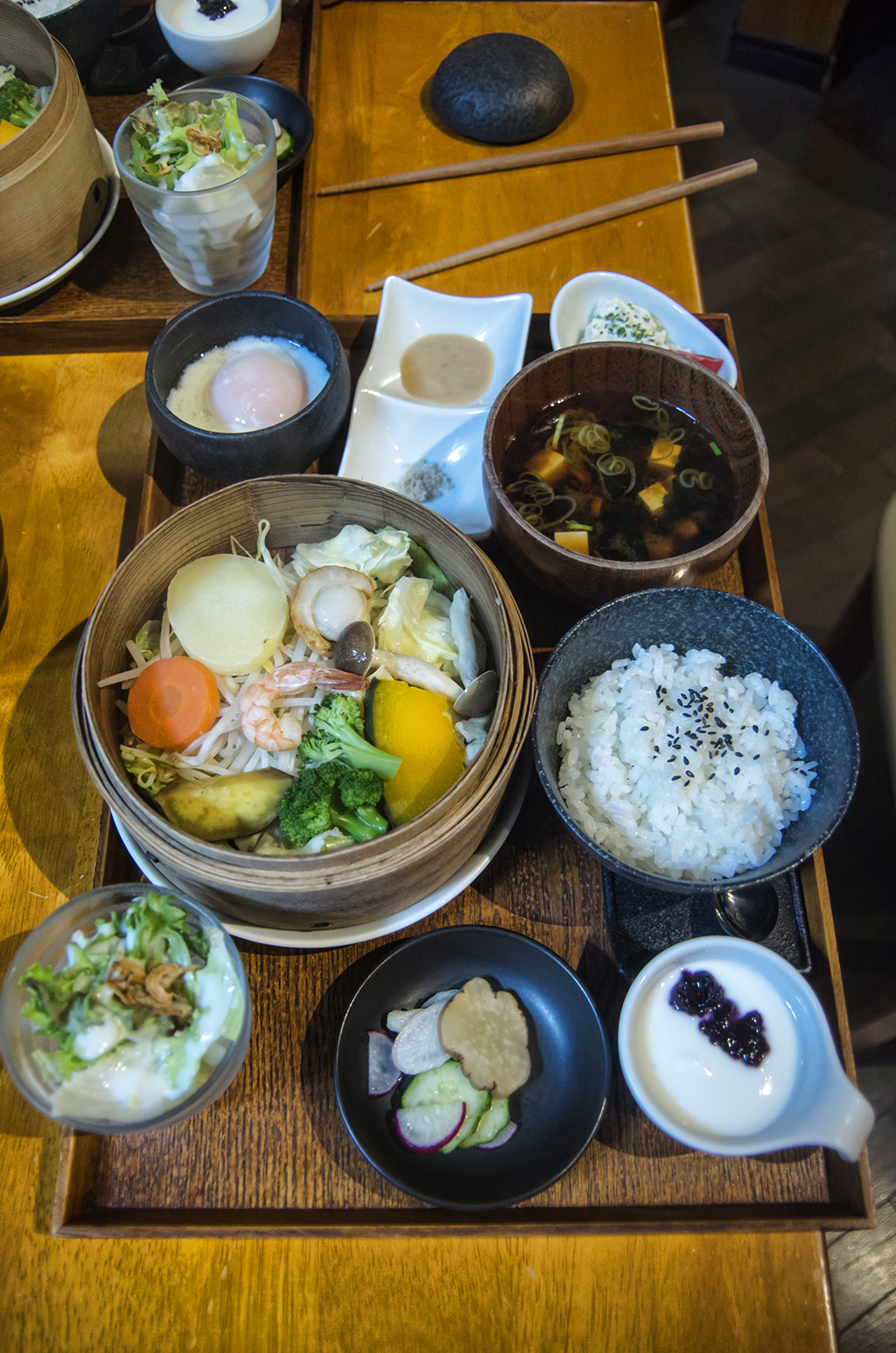
Tazawako breakfast
OK, more about food. Japanese breakfast to be specific. Which consists of many small plates of things - usually some fish (often smoked or dried, like kippers), always soup and rice, some vegetables or even salad, maybe a little fruit, and definitely pickles. Maybe omelette (which is sweet), or an ‘onsen egg’ (poached in warm water so it is just slightly cooked), or even raw egg. The thing is - it’s basically lean protein (fish, egg) with vegetables, so very healthy, and a great start to the day. We have had some really lovely breakfasts, some a bit ordinary, I love them all, Chris is not so keen on the salad for breakfast, or the dried fish. The only dish I can’t quite love is ‘natto’, a fermented bean dish that’s unbelievable slimy (and apparently amazingly good for you). The best breakfast? Maybe Tazawako, where it was so fresh and lovely, with steamed vegetables, prawn and scallop, onsen egg, salad, yoghurt with berries. But I also loved Dormy Inn, where it was a buffet with so many options, I got to try lots of things, such as octopus fritters, and nori-wrapped apricots, and pickled plums. If I could have just one Japanese meal a day I think it would be breakfast.
(Disclaimer - I am really slack at photographing food! A hopeless foodie really).

SOUVENIR STAMPS

Stamps! Hirosaki and Yamagata
It’s an old fashioned kind of thing, but collecting stamps (that is, inked designs that are pressed onto a book, or commemorative sheet of paper) is huge in Japan. The idea is to have sets of stamps for a particular region, or season, but mine are quite ad hoc, just collected wherever I happen to see a stamp and pad. Often at train stations, sometimes museums, or at particular tourist sites, they are quaint, and a bit cheesy and I love them. Unless the inkpad has dried out! Grrr.

SUMMER FLOWERS AND GARDENS

Japanese lacecap hydrangea
So we have missed the blossom season, and the autumn leaves are yet to come. The rainy season in June washes away many of the spring blossoms, but summer has some floral pleasures of its own. Hydrangeas are ubiquitous, and flower copiously, even growing wild. There is a particular Japanese ‘lacecap’ variant that is particularly pretty. Large scented lilies are also seen everywhere, and also grow in profusion in the wild, although a display near Mt Fuji was particularly stunning. Iris are very frequently planted in and around water in huge beds in traditional gardens, but we are at the end of the season and the flowers are now a little sparse. Lotus is often a feature of temple gardens, growing so large I feel as if I have been shrunk in size. Amazing large lakes full in Ueno Park (Tokyo). Japanese, though living in an urbanised environment, adore nature and will visit parks and gardens, as well as cultivate their own gardens, assiduously. In the northern parts, where snow covers the ground for a large part of the year, summer water is plentiful, and great vegetable garden areas are cultivated between buildings even in built up areas. And even rice fields!

Lilies at Oishi Park (Mt Fuji)
Rice paddy - somewhere between Fuji and Tokyo

Vegetable garden - as above

Lake of lotus - Ueno Park, Tokyo

Wild lilies


Japan: Honshu 1 - Hirosaki to Hiraizumi

13 July - Hirosaki

Hirosaki Park and castle
Hirosaki izakaya
Hirosaki downtown

At Hirosaki, first stop in Honshu, the main attraction is a large local park with historic castle tower and botanic garden. Here we are staying at Dormy Inn, a Travelodge-type chain of hotels, but very Japanese. It’s as bland as could be, but in Japan all is oriented to personal comfort - there are slippers, pyjamas (in lieu of the traditional yukata), and a very nice rooftop onsen. The buffet breakfast is fabulous, and there is free ramen in the evening, all for the price of a cheap guest house (about $125/night). Dormy Inn is quite close to the park, and also close to the downtown area full of bars and restaurants. After a brief walk in the park we find a little yakitori joint where they seem quite thrilled to have gaijin tourists. It’s as basic as they come, we have to point to the skewers we want, but the chicken livers are delicious!

14 July - Hirosaki

Hirosaki Castle tower

So it’s hot. Damn it’s hot! The heatwave continues and 34C is forecast today. We climb the castle tower, skip between shady spots at the Botanic Garden, lunch in a beautiful old European-style tearoom at the Fujita Memorial garden, it’s cool and the food is good - smoked salmon buckwheat crepe, apple pie, apple juice (Hirosaki is Apple city!). The garden is gorgeous too - if only we could see it in a drizzly mist instead!

Fujita garden 1
Fujita garden 2
Fujita garden tearoom
Playing dress-up in Hirosaki Park
After the garden, back to Dormy Inn for onsen and siesta - aaaah. For dinner tonight, we check out a small food court recommended by the Rough Guide. We manage to locate the ‘Home Cooking’ shop, run by mother and daughter. They and patrons are in a frivolous Friday night mood, and happy to indulge a couple of poor gaijin, thought there is not two words of English between them, nor two words of Japanese between us. We eat edamame, tempura corn, scallops in egg, squid fritters, and a weird dried cod/raw egg dish. Other customers insist that we try their food, and top up our sake glasses. It’s all a lot of fun and quite yummy and costs us about $20 each.
Next - we head to Tazawa-ko, where the forecast is cooler, and wet. Phew.

15 July - Tazawa-ko

Tazawa-ko - drizzly lakeside

We have arranged a bus stop pick up at the slightly remote location of Tazawakohan, lakeside at the deepest lake in Japan. It’s a warm and sunny lunchtime, and we envisage walks and swims in the lake. Tazawa-ko (Lake Tazawa) is in a very scenic area, but the weather turns, and some welcome rain arrives, so we will not have much chance of sightseeing or swimming. As it turns out it is not anyway such an easy place to walk or swim. There is no footpath along the narrow road bordering the lake, and very little access to the lakeside, unless we go into the village 15-20 minutes away.

The place we are staying in (‘That sounds good! Cafe and Inn’) is a jazzy hippie guest house over the road from the lake, and our loft apartment has lovely lakeside glimpses through the trees. Just as well, as we are captive to the weather for the next day. The place also has a small private onsen that we can book to bathe together - what a treat, for me at least!

16 July Tazawa-ko

Tazawako dining room/bar
We are captive not only to the rain, but with no access to the town, also to the guest house restaurant. Fortunately it is beautiful, fresh, veggie-based home cooking by Yuli, a little on the pricy side, but a welcome respite from all the fast-food picnics. And the breakfast is just gorgeous! (See my post re Breakfasts). On the first night friends of Tatsuya, our host, come to celebrate a birthday and play some jazz. We so wish we could speak Japanese and join the party! Over two days we eat: Veggie gratin, veg soup, octopus salad, braised pork, home made bread, margarita pizza, and spaghetti al vongole (the best!).

Yuli - Tazawako cook and hostess
On the train again ...

17 July - Hiraizumi

Historic Hiraizumi
Our very solicitous hosts ...
... and the lovely apartment
Old-style - Hiraizumi town centre

At Hiraizumi, a small, neat and old-fashioned town with deep history, we are unexpectedly met at the train. That personal level of welcome and service continues at the guesthouse. Unexpectedly it is a single apartment of two large rooms attached to a family house (we are the only guests). We have our own toilet and basin, but the bathroom is (as usual) shared. There is loads of space, but in traditional Japanese style - almost no furniture. ‘Where am I to sit?’ asks Chris. We have to pass through our hosts’ private space to shower, or even to go out, and they are endlessly attentive: Can we drive you? Let us show you the way! Where have you been? How was it? Can I change your sheets? Oh, how kind and lovely they are, and I can’t help wishing they would leave us alone!

Hiraizumi was once the area selected for development of ‘The Pure Land’ of Japanese Buddhism, and while it has a population of less than 8000, its cultural sites have UNESCO World Heritage status. The incredible array of temples mostly long since destroyed, but the gardens, with some stone foundations, remain, as well as the famous ‘Golden Temple’ of Chuson-ji. The guest house is close to two of the historic temple sites, Motsu-ji, which still has some temple buildings, and Kanjizau-in, with a ‘Pure Land’ garden bereft of temples. We explore the two sites, and in the park find a nice spot (where young boys are fishing) for drinks later.

Then - look for a dinner place, but it’s Monday night in a small town and almost everything is closed. I find a likely restaurant on google maps, and it too is closed when we reach it. However, a family-type restaurant over the road is open, and we have the usual job of selecting dishes (tempura/noodle set and pork/noodle set) by pointing at the pictures. (Set means a complete meal including rice, soup and accompaniments). We do wonder how limited our choices are by our lack of language, but it’s pretty good, washed down with a local sake, for less than $20 each. On the way home, a storm arrives and we are drenched - no park drinks tonight!

18 July - Hiraizumi

It’s going to be hot (again!) so we set out early for Chuson-ji. It’s just opening up, and all is cool, quiet, damp and lovely. The Golden Temple is taken care of early. It’s impressively golden, under cover in a custom-built controlled environment, and no photos allowed. The rest of the day is a blissful meander from mossy rock to rustic shrine, to crumbling lantern, with the odd fire hydrant thrown in. There's also an excellent museum nearby that illuminates the history of Hiraizumi, like most histories it is complicated so look it up if you are interested!

By 2pm we are home, after a good soba noodle soup, feeling very satisfied. Our host recommends a restaurant for dinner - it is the one we found closed yesterday! It turns out to be in the family home of a young, well-travelled and articulate Japanese chef, who is running his small restaurant mostly single-handed. We eat snapper and vegetables and a veg and pecorino spaghetti. It’s excellent.

Early morning at Chuson-ji Temple complex
Cool and green at Chuson-ji
Chuson-ji souvenir seller
Suburban rice paddy on the way to the restaurant
Our first meeting with Matsuo Basho ...